
Microsoft Features: Microsoft Purview Data Security Posture Management, Microsoft Purview Data Loss Prevention
Estimated Read Time: 7 minutes
AI adoption is happening quickly, and unfortunately, not all of it is happening through the AI applications that organizations have formally approved. Users may turn to third-party AI applications to summarize a document, analyze information, rewrite content, or simply help them complete their work faster. The challenge for security teams is determining what enterprise data is leaving the organization, where it is going, and whether that activity should be
allowed or blocked.
I recently discussed this problem during my lightning talk at Microsoft Ignite, “Shadow AI Data Leaks: Protect Data with Microsoft Purview DSPM”. With only 15 minutes, my goal was to demonstrate one practical workflow: using Microsoft Purview Data Security Posture Management (DSPM) to discover third-party AI usage and then using Data Loss Prevention (DLP) to put controls around sensitive data sharing. But there is quite a bit more nuance behind addressing shadow AI that I would like to dive deeper into with you all.
In this blog, we will review where this protection fits, what administrators can learn from it, and most importantly, what it does not protect (and how to fill those protection gaps).
The Data Security Concern
When we talk about Shadow AI, it is easy to focus on the application.
Are employees using ChatGPT? Claude? Perplexity? DeepSeek?
That is useful information and context, but knowing that an employee visited an AI application does not necessarily give us all the context we need to determine whether something risky happened.
The important question to ask is:
What sensitive enterprise data is being shared with those applications?
By gaining visibility into third-party AI usage, organizations can then make informed decisions and technical policy configurations to block risky activities while allowing productive, approved usage. Depending on the organization and its risk tolerance, the answer to “Should we enforce an outright block on the application? Or should we allow users to leverage the application while blocking sensitive data sharing?” will be different.
Instead of immediately treating every third-party AI application as something that needs to be blocked, organizations should consider the application, the data being shared, and the business scenario before deciding how to respond.
For example, an organization may be comfortable allowing employees to use an approved third-party AI service for general research, while still prohibiting customer financial information, regulated data, or restricted documents from being shared with that service.
On the other hand, for some third-party AI, organizations may want to enforce an application-level block due to the evaluated risk.
Start by Gaining Visibility into Shadow AI Usage
Before deciding what to block, administrators need to gain visibility into the current data risk landscape.
Microsoft Purview DSPM provides visibility into AI usage and associated data security risks. In the scenario I demonstrated at Ignite, several prerequisite configurations supported this visibility and are listed on the DSPM setup tasks page.
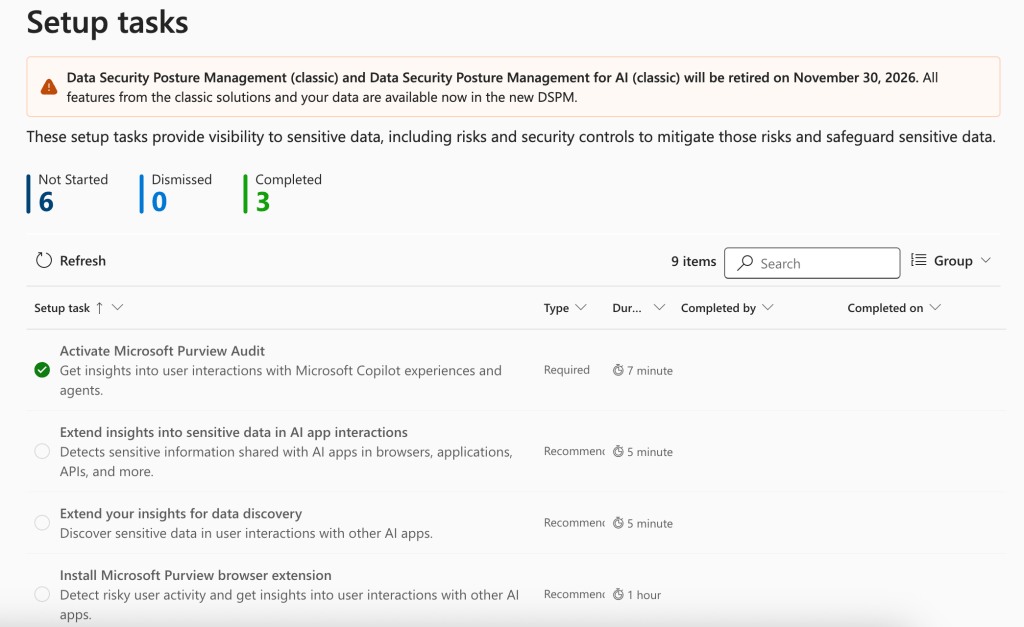
Two particularly important policies to highlight are:
- An Insider Risk Management policy to identify users visiting AI sites.
- An Endpoint DLP policy running in audit mode to identify sensitive information being pasted or uploaded to AI sites.
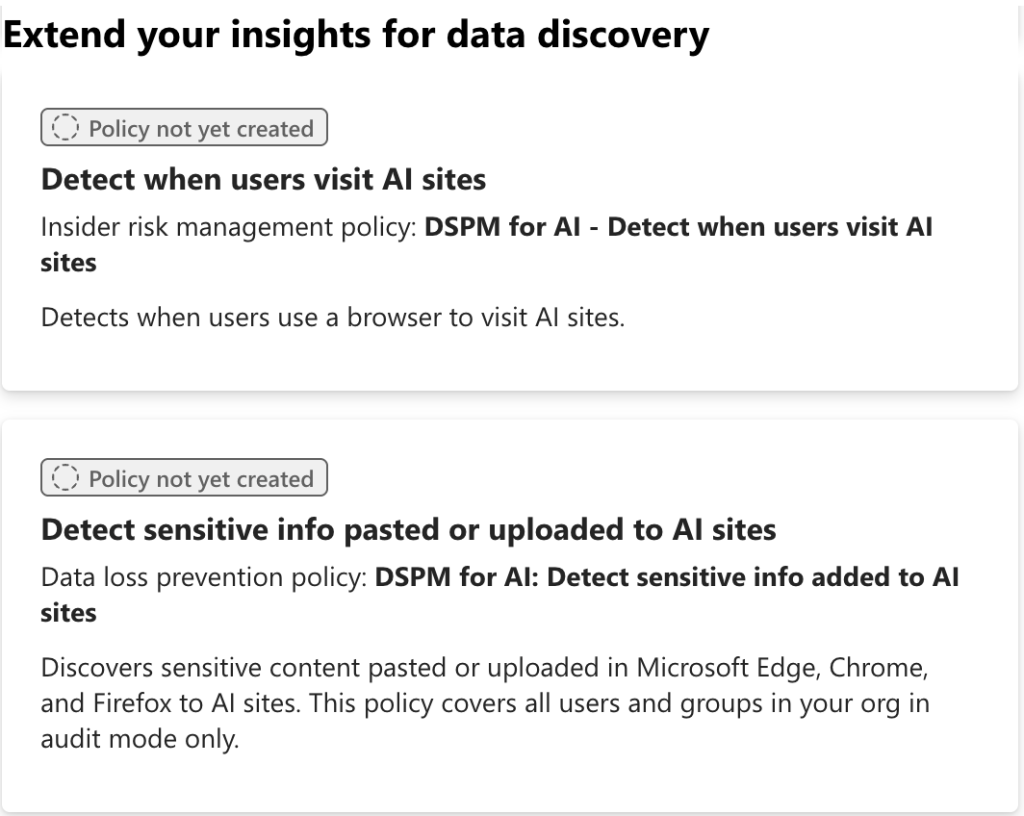
Once the policies are configured and insights are collected, administrators can use the AI Usage and Risk report along with Activity Explorer in DSPM to investigate recent third-party AI activity. Administrators can review context such as the application involved, the user, and whether sensitive information was recognized.
It is important to note that the objective at this stage isn’t necessarily to enforce blocks. Instead, we want to start by understanding the current state and where the risk lives.
Microsoft Purview can therefore help answer questions such as:
- Which third-party AI applications are employees using?
- Which users are interacting with those applications?
- Is sensitive information involved?
- Which activities appear to present the greatest data security risk?
Balancing Security and Productivity while Addressing Shadow AI Risk
Although the first response that many security teams tend to have when they discover Shadow AI is to block all third-party AI usage, a blanket block isn’t necessarily the right answer for every organization or every AI application.
In my Ignite session, I described this decision process as Assess, Protect, Block:
- Assess the application, data, and business scenario.
- Protect sensitive information while allowing an acceptable business use to continue.
- Block applications or scenarios where the risk is unacceptable.
This distinction between “Protect” and “Block” matters because third-party AI isn’t inherently synonymous with prohibited AI. It is important for organizations to make an informed and risk-based decision regarding their response to third-party AI usage.
Note: Remember! If data security controls are too restrictive, users will find another way to achieve their task goals. Often, this “other way” is ungoverned, invisible, and uncontrollable. This, among many other reasons, is why it’s so important to strive for balance between security and productivity.
Controlling Sensitive Data Sharing to Third-Party AI with Endpoint DLP
Once organizations understand their AI usage and the risk boundaries are established, Endpoint DLP can move from providing visibility to enforcing those guardrails.
Imagine that an organization has approved the use of a particular third-party AI application, but customer financial information is not permitted to be shared with it. An employee can continue using the application for acceptable activities. For example, the user could ask ChatGPT for an update on AI news without the interaction being blocked.
But the endpoint DLP policy blocks activities when sensitive data enters the workflow as a means of protecting it. If the same employee copies a customer credit card number and attempts to paste it into ChatGPT, Endpoint DLP will intervene. Similarly, a policy can control the upload of a document containing sensitive information to the AI application.
Depending on the organization’s requirements, administrators can configure the DLP response to provide different levels of enforcement, including notifying the user with a policy tip, blocking the activity, and optionally allowing users to override the block after providing a business justification.
What Endpoint DLP Protects (and what it does not)
The Endpoint DLP scenario I described above is NOT a blanket control for every possible interaction with third-party AI.
Several scenarios that this policy does not cover include:
- Prompts manually typed into AI websites
- Office add-ins and API calls
- AI responses or files coming back into the organization
- SaaS sessions occurring on personal or otherwise unmanaged devices
- Screenshots of managed SaaS applications or sensitive information
Although this endpoint DLP policy does not give you visibility or protection for every path through which enterprise information could reach an AI service, this doesn’t make the policy ineffective. It simply means that we need to implement a layered control model that works together to cover AI-related data flows comprehensively.
A Layered Control Model
DSPM gives administrators the visibility needed to better understand shadow AI activities and prioritize where protection should be introduced. Endpoint DLP provides an important control for sensitive data leaving managed devices through supported user activities (e.g., copy/paste, file upload).
However, organizations protecting against third-party AI data leaks should also understand how different DLP enforcement points complement one another. For example, network DLP and browser DLP provide control to several data paths and AI usage scenarios that endpoint DLP does not (e.g., prompts manually typed into AI sites).
- https://learn.microsoft.com/en-us/purview/dlp-network-data-security-learn
- https://learn.microsoft.com/en-us/purview/dlp-browser-dlp-learn
Moving from Shadow AI to Controlled AI
Here is a simple operating model that I think is useful well beyond the individual DLP policy to move from shadow AI to controlled AI:
Discover. Decide. Protect.
1. Discover
Understand which AI applications and interactions exist within your environment. Don’t begin by assuming you already know how employees are using AI. Use the available telemetry to establish the current state and identify where sensitive enterprise information may be involved.
2. Decide
Determine which applications, data flows, and business scenarios are acceptable. This shouldn’t be a security-team-only decision. Business stakeholders need to participate because they understand the business value of the workflows being evaluated. Written policy support is important here because these policies provide a common definition of acceptable behaviour that technical controls can then enforce.
3. Protect
Finally, apply risk-tailored guardrails to effectively protect and control the organization’s usage of AI. Start with a focused scenario, validate the policy against real-world activity, and expand from there.
Before broadly introducing blocking controls, I recommend testing to confirm legitimate workflows continue to work. This aligns with the iterative DLP deployment approach I have discussed previously, where organizations begin with monitoring and use the resulting data to tune policies before increasing enforcement.
It is important to note that this operating model is not a one-time process. As third-party AI adoption, Microsoft Purview capabilities, and your organization’s own AI policies change, organizations will need to iterate on their AI data security controls.
Closing Thoughts
Moving from Shadow AI to controlled AI is becoming simultaneously more important and more complex to achieve as the pace of change continues to increase. By gaining visibility into Shadow AI usage with DSPM, ensuring that both business and technical stakeholders align on risk-tailored control decisions, and implementing a layered control model, organizations can move towards control in their AI data security posture.

